Ask a Huntington Beach condo board when they finished their state-mandated balcony inspection, and you'll often get a confident answer citing a 2026 deadline. That answer is wrong, and the mistake matters more this year than it ever has.
The law that actually governs condominium associations, Senate Bill 326, required inspections of balconies, decks, walkways, and stairways by January 1, 2025, with no extension granted. The law that got pushed back a year, to January 1, 2026, covers apartment buildings under a separate statute, SB 721. HOA attorneys have spent the better part of this year correcting boards that conflated the two. If your building's association believes it has another few months to comply, it's operating on the wrong calendar, and that confusion is now colliding with a second law that changes what shows up in your escrow paperwork.
Two Laws, One Date That Never Moved
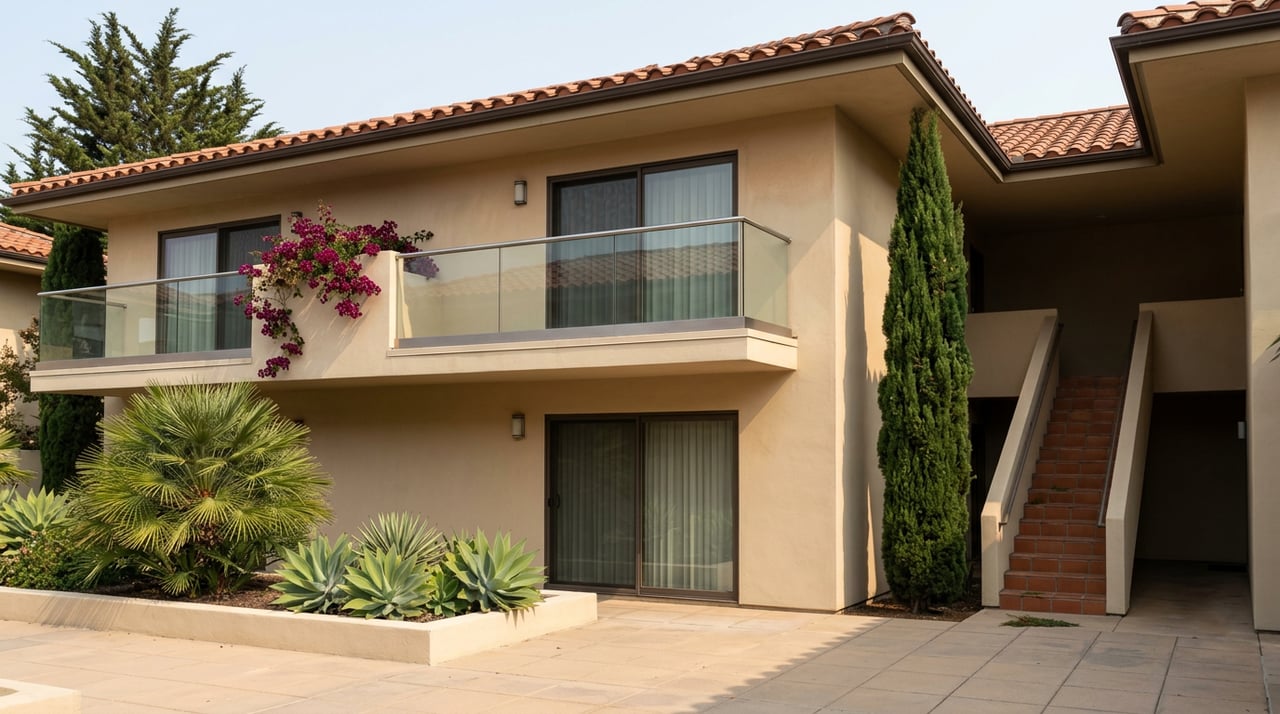
SB 326 added Civil Code Section 5551 to the Davis-Stirling Act. It requires any condominium association with three or more units to inspect exterior elevated elements that sit more than six feet above ground and are supported substantially by wood: balconies, decks, walkways, stairways, and their railings. The inspection has to be done by a licensed structural engineer, architect, or, since a 2024 update, a licensed civil engineer. The first inspection cycle closed on January 1, 2025. The next one comes nine years later.
SB 721, the apartment-building version of the same idea, got a one-year reprieve through Assembly Bill 2579, moving its deadline to January 1, 2026. That bill explicitly excluded homeowners associations from the extension. Every HOA law firm that has weighed in on the confusion this year says the same thing: boards that assumed the apartment deadline applied to them are not early, they're a year late.
The deadline for apartment buildings moved. The deadline for your condo association did not.
For a buyer or seller, the practical question isn't which law is correct. It's whether your building's association can produce a report at all, and if so, from when.
The New Item In Every Resale Package
Here's what actually changed on January 1, 2026, and it isn't the inspection deadline. It's the paperwork attached to selling.
California's resale disclosure statute, Civil Code Section 4525, lists what a seller's HOA has to hand a buyer during escrow: governing documents, budgets, insurance summaries, notice of any unresolved violations, and more. A 2025 bill authored by Assemblymember Grayson, SB 410, added a new line item to that list: a copy of the most recent Section 5551 inspection report. That amendment took effect January 1, 2026, which means this year is the first full selling season where a Huntington Beach condo association legally has to hand over its balcony inspection findings as part of the standard resale package, not as a special request from a cautious buyer's agent.
If the report exists and it's clean, this is a formality. If the report doesn't exist, its absence becomes a disclosure item in its own right, and a buyer's lender may notice before the buyer does.
The Same City, Two Different Cost Structures
Huntington Beach condo dues aren't uniform, and the spread tells you more about a building's balcony history than its amenities do. Monthly dues across several established complexes look roughly like this:
| Community | Typical Monthly HOA Dues | What's Included |
|---|---|---|
| Brightwater | $250–$350 | Standard maintenance |
| Surfcrest | $375–$400 | Standard maintenance |
| Beachwalk | $437–$509 | Roof and exterior maintenance |
| Seabridge | $705–$780 | Insurance-heavy, elevated reserve funding |
Seabridge is a gated community off Beach Boulevard near Adams, made up of 422 townhomes and 344 condos built in 1987. Its dues have climbed to that upper range after what's been reported as a 136 percent increase, driven primarily by rising insurance costs layered on top of the reserve funding SB 326 required once the balcony inspection surfaced deferred maintenance. Nothing about Seabridge's location, unit count, or amenities explains that gap on its own. What explains it is a report that told the board exactly how much wood-framed structure needed attention, and a reserve fund that had to catch up fast.
This is the pattern buyers should look for citywide, not just at Seabridge. A dues figure that sits well above comparable buildings nearby is often a lagging indicator of a balcony reckoning that already happened. A dues figure that looks suspiciously low, in a building old enough to have wood-framed decks, may mean the reckoning hasn't happened yet.
The Land Lease Complication
Two other Huntington Beach communities add a wrinkle that has nothing to do with balconies but everything to do with reading the full monthly cost. Harbour Vista and The Gables both carry HOA dues plus a separate land lease payment, since the associations don't own the ground under the buildings. At Harbour Vista, the HOA fee of roughly $708 to $733 a month covers trash and hot water, but the land lease is billed on top of it. At The Gables, HOA dues run $316 to $350 a month, with a land lease of about $700 to $766 added in, pushing the combined monthly obligation past $1,050 before a mortgage payment enters the picture.
Land leases also affect financing. Some lenders won't write conventional loans on leasehold property at all, which narrows the buyer pool and can slow a sale regardless of how well the building has handled its balcony inspections. None of this shows up on a listing sheet. It shows up in the HOA disclosure packet, which is exactly why reading that packet before writing an offer matters more than reading the marketing photos.
What a Bad Report Actually Costs
Statewide, the numbers behind a failed or overdue balcony inspection have gotten real. Individual balcony repairs have run $10,000 to $25,000 apiece in reported cases, and when an association has to fund a broader package of exterior repairs at once, per-unit special assessments have landed in the $40,000 to $60,000 range, with attorneys citing outlier cases as high as $175,000 per unit.
That's not a hypothetical. In September 2026, Moneywise reported on a Torrance homeowner facing a $49,000 special assessment after her HOA rolled $19 million in deferred projects, including balcony-related work required under SB 326, into a single funding push. The attorney who reviewed the case for that story described it as part of a broader pattern of underfunded reserves catching up with California condo associations all at once. Torrance isn't Huntington Beach, but the reserve dynamics are identical, and coastal buildings with wood-framed decks and salt air exposure are exactly the profile this law was written for.
What to Ask For Before You Write or Accept an Offer
The documents that matter now go beyond the standard reserve study. Before you're deep into contingency periods, request:
- The most recent Section 5551 exterior elevated element inspection report, and the date it was completed
- The current reserve study, and whether it reflects the balcony inspection findings
- Any special assessments approved by the board but not yet due, which California law requires the HOA to disclose separately
- The master insurance policy renewal terms, since carriers are increasingly asking about SB 326 compliance before renewing coverage
- The association's assessment history for the past several years
None of this requires a specialist. It requires asking for the right document by name and reading the date on it, since a report from a few years into a nine-year cycle is current, while no report at all is the actual red flag.
A Few Questions Worth Asking
Does this apply to my HOA if it's a planned development, not a true condominium? Not necessarily. SB 326 applies to condominium common interest developments where the association is responsible for maintaining the building exterior. If your community is legally structured as a planned development, where each owner holds title to their own exterior walls and roof, the maintenance obligation often falls to the individual owner instead. Your CC&Rs will spell out which structure applies.
What if the HOA already inspected years ago? Do I need to worry? Ask for the date of the most recent report, not just whether one exists. A report completed in 2020 or 2021 is likely still current within the nine-year cycle. The risk concentrates in associations that have never completed the requirement at all.
Can a special assessment show up after I've already closed escrow? It can, if the board approves it after your purchase closes. California law does require associations to disclose any assessment changes that have been approved but aren't yet due and payable at the time you receive your resale package, which is one more reason to request that document early rather than assuming a clean reserve study tells the whole story.
The balcony report used to be a document that sat in a management company's file cabinet. Now it travels with the sale, and it can tell you more about a Huntington Beach condo's real cost of ownership than the square footage or the view ever will. If you're weighing a purchase or a sale in one of these communities and want someone who reads these packets the way a contractor would, not just the way an agent would, reach out to Joseph Cordi and let's go through the paperwork together before you write the offer.